
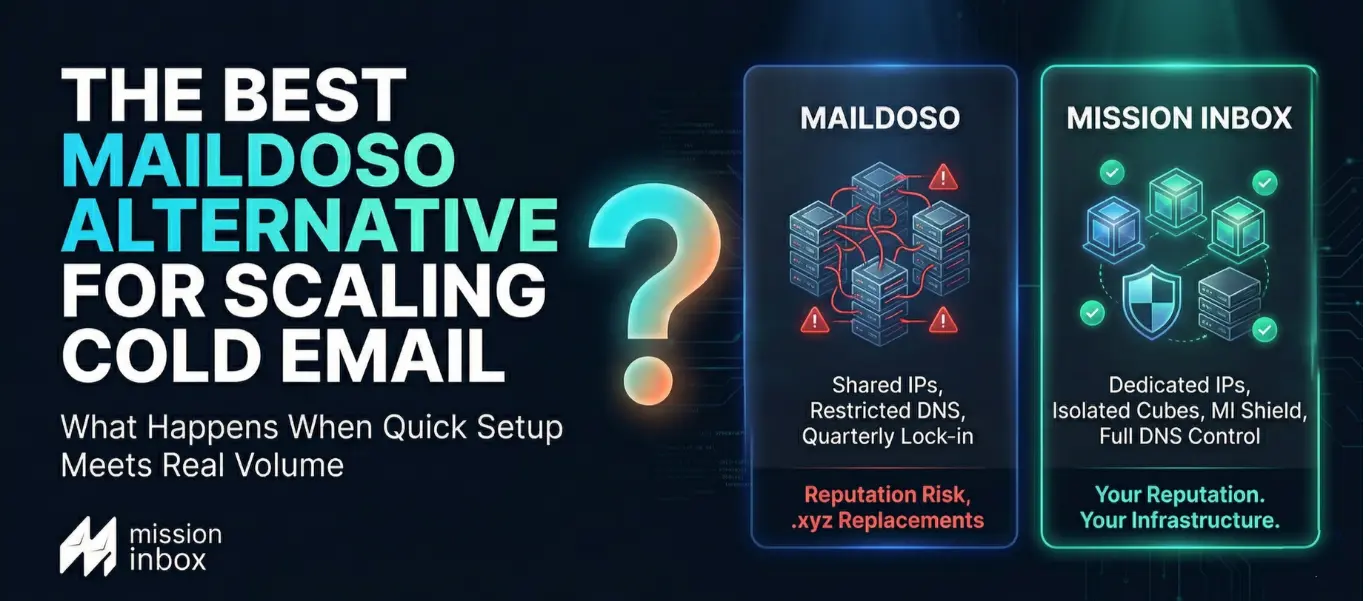

The Best Maildoso Alternative for Scaling Cold Email: What Happens When Quick Setup Meets Real Volume
Author: Anthony Baltodano | Published: March 2026 | Reading time: 12 min
It Works at 20 Mailboxes. The Problems Start at 100.
Maildoso is one of the fastest cold email infrastructure tools to set up. Buy domains, create mailboxes, configure DNS automatically, start sending. Ten minutes from signup to first email. For solo founders and small teams testing cold outreach, that speed is genuinely valuable.
But the teams we talk to every week are not testing cold outreach. They are running it at scale. Agencies managing 50 to 400 mailboxes across dozens of client campaigns. Financial services companies sending 100,000+ emails per day. SaaS platforms integrating email into their product. B2B sales teams with 10 SDRs sending simultaneously.
And at that scale, Maildoso's architecture creates problems that compound faster than they can be fixed.
The SMTP mailboxes send from shared IPs. DNS control is restricted. Domain replacements come as .xyz or .click instead of .com. There is no pre-send protection. Quarterly billing is required upfront with no monthly option. And for agencies, the dashboard has no folder structure, no account grouping, and no way to isolate client campaigns from each other at the infrastructure level.
These are not feature requests. They are structural limitations documented across 150+ G2 reviews, multiple competitor analyses, and direct user feedback.
If your cold email operation has outgrown quick setup and needs infrastructure that scales without breaking, here is the comparison that matters.
At a Glance: Maildoso vs. Mission Inbox
→ Start Sending with Mission Inbox | Book a 45-Min Walkthrough
What Maildoso Does Well (Being Honest)
Before explaining why we built Mission Inbox differently, Maildoso deserves credit for what it gets right.
Setup is fast. Creating mailboxes and configuring DNS takes under ten minutes. For someone launching their first cold outreach campaigns, the experience is smooth and accessible.
Domains are included in pricing. Unlike platforms where you purchase domains separately, Maildoso bundles domains into their plans. Fewer steps, less friction.
Inbox placement monitoring exists. Maildoso includes deliverability checks that show whether emails are reaching inboxes or getting filtered. Basic, but present.
Support gets positive reviews. Multiple G2 reviews praise the support team as responsive and proactive when issues arise.
For solo founders sending from a handful of mailboxes at low to moderate volume, Maildoso is a functional starting point. The architecture makes sense at small scale.
The problems appear when you scale. And they appear fast.
Where Maildoso Breaks Down at Scale
Shared SMTP Infrastructure Means Shared Risk
Maildoso's SMTP mailboxes send from shared IP infrastructure. IP rotation happens automatically in the background, but the IPs are shared across Maildoso's user base.
This creates the same structural vulnerability every shared platform carries: if another Maildoso user on your IP pool sends poorly, triggers a blacklist, or gets flagged by Microsoft, your deliverability drops alongside theirs.
Your sender score, your content quality, your list hygiene. None of it protects you from what someone else on the shared pool does. The risk is structural. It does not go away with better sending practices.
Limited DNS Control Restricts Your Flexibility
Multiple G2 reviewers document that Maildoso restricts DNS configuration. Users report being unable to connect their Maildoso domains to other tools or services because DNS settings are locked down.
For teams using multiple tools across their outreach operation (sequencers, CRMs, analytics platforms), restricted DNS means restricted flexibility. You cannot fully integrate a domain you do not fully control.
Mission Inbox takes the opposite approach. Bring your own domains. Full DNS control. Automated configuration via API through Cloudflare, GoDaddy, and Spaceship. Your domains are yours.
Domain Replacements Come as .xyz and .click
When Maildoso users lose domains, replacements arrive as .xyz or .click instead of .com. This is documented across multiple G2 reviews.
In cold email, the domain extension matters. A .com domain carries inherent trust. A .xyz or .click domain raises red flags with both recipients and filters. For sales teams emailing executives at enterprise companies, a .click domain in the sender address creates an immediate credibility problem.
Mission Inbox does not manage your domains for you. You bring your own. You choose the extension. You own them permanently. If you ever leave Mission Inbox, every domain comes with you.
No Pre-Send Protection
Maildoso has no content scanning before emails leave the server. Whatever your team queues gets sent. If one SDR writes an email with aggressive language, risky links, or formatting that triggers filters, the email goes out and the domain reputation takes the hit.
You discover the problem when deliverability metrics drop 24 to 72 hours later. By that point, the damage is already compounding across every mailbox on that domain.
Quarterly Billing Only. No Monthly Option.
As of 2026, Maildoso requires quarterly billing. The entry plan is $299 per quarter for 32 mailboxes. There is no monthly option.
For teams wanting to test the platform before committing, this is a real barrier. You are paying for three months of infrastructure before sending your first campaign.
Mission Inbox bills monthly with prorated billing. You pay for what you use each month. Scale up or down without being locked into a quarter.
The Agency Problem: No Client Isolation
For agencies, Maildoso's dashboard has no folder structure, no account grouping, and no infrastructure-level client isolation. All client campaigns run on the same shared SMTP infrastructure.
One client runs an aggressive campaign. Open rates drop across all your other clients. There is no architectural separation between them. The damage is shared because the infrastructure is shared.
This is the sharpest version of the shared IP problem, and it is exactly what agencies need to solve first.
How Mission Inbox Solves Each of These Problems
Isolated Cubes: No Shared Anything
Every email workload on Mission Inbox gets its own dedicated server environment. Sales runs separately from marketing. Marketing runs separately from transactional. Each workload has its own dedicated IPs and its own reputation.
For agencies, each client runs in their own Cube. One client's aggressive campaign literally cannot touch another client's deliverability. The damage radius is contained by architecture.
Subdomain Isolation: Protect Your Root Domain at Scale
Mission Inbox is the only provider offering true subdomain isolation at the IP level. Send from subdomains that leverage your root domain's reputation while keeping all risk completely contained.
One financial services client sends 120,000 emails per day from subdomains with zero reputation damage to their root domain. No other infrastructure provider offers this level of protection.
MI Shield: AI Protection Before the Email Leaves
MI Shield scans every outbound email before it enters the sending queue. Content structure, link safety, wording patterns, DNS configuration. All checked in real time. If anything could trigger filters or damage reputation, the email is blocked before it sends.
One SDR cannot burn the domain. The send never happens. The team gets alerted. The domain stays clean.
Blacklist Monitoring Every 7 Minutes With Auto-Failover
Mission Inbox checks for blacklists automatically every 7 minutes across 90+ sources. If an IP gets flagged, it is removed from rotation instantly. Other IPs continue sending without interruption. Zero downtime. Zero manual intervention.
Full DNS Control and Domain Ownership
You bring your own domains. You own them. Full DNS control through automated API integration with Cloudflare, GoDaddy, and Spaceship. No restrictions on connecting domains to other tools. No .xyz replacements. Full portability if you ever leave.
One team manages 3,000 active sending domains from a single API integration.
Superior Microsoft/Outlook Delivery
Dedicated IPs with established reputation deliver consistently to Outlook, Hotmail, and Live.com addresses, including enterprise environments behind Proofpoint and Barracuda. Where shared SMTP infrastructure is most vulnerable to Microsoft's aggressive filtering, isolated architecture is strongest.
→ Start Sending with Mission Inbox | Book a 45-Min Walkthrough
Who Should Stay with Maildoso (Honestly)
Maildoso is a reasonable choice for specific situations:
- You are a solo founder or freelancer doing basic cold outreach with under 30 mailboxes
- You want domains included in pricing without purchasing separately
- You do not need workload isolation between campaigns or clients
- You are comfortable with shared SMTP and the IP risk that comes with it
- You do not need full DNS control over your domains
- You are fine with quarterly billing and do not need monthly flexibility
- You do not send significant volume to Microsoft/Outlook enterprise addresses
Who Should Choose Mission Inbox
Mission Inbox was built for teams where deliverability is directly tied to revenue:
- Agencies managing multiple client campaigns who need infrastructure-level client isolation. One client's bad campaign cannot touch another's deliverability.
- Financial services companies where compliance emails cannot share infrastructure with cold outreach. Regulatory email and sales email stay completely separate.
- B2B sales teams with multiple SDRs who need AI pre-send protection. One poorly written email from one team member cannot burn the domain for everyone.
- Teams sending to Microsoft/Outlook enterprise addresses at volume. Dedicated IPs deliver through Proofpoint and Barracuda where shared SMTP gets blocked.
- SaaS platforms that need white-label email infrastructure via API. OBM Engine provides sub-50ms latency with isolated sending per customer.
- High-volume senders who need subdomain isolation to scale past 100,000 emails per day without risking their root domain.
- Any team that wants full DNS control, full domain ownership, and monthly billing without quarterly lock-in.
- Teams using Instantly, Smartlead, or other sequencers who want the best possible delivery layer underneath their existing workflow.
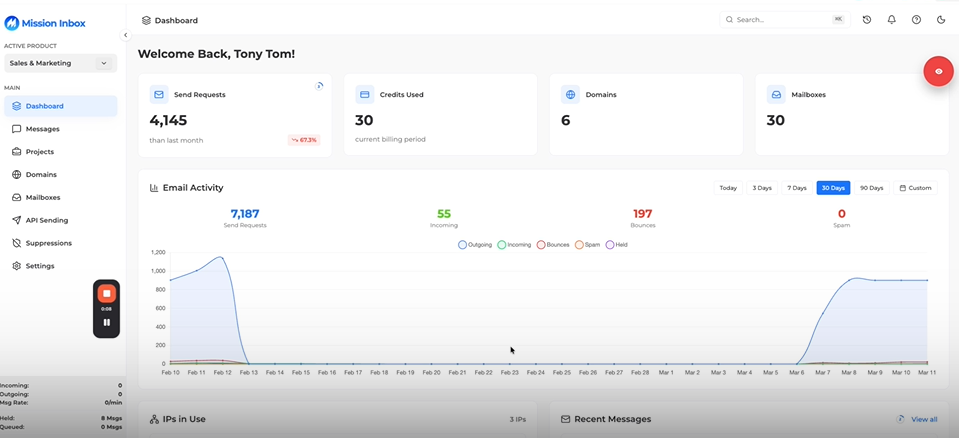
See Mission Inbox in Action
Watch a complete platform walkthrough. Isolated Cubes, MI Shield, dedicated IPs, domain management, and how it integrates with your existing sequencer.
Frequently Asked Questions
What is the main difference between Maildoso and Mission Inbox?
Maildoso uses shared SMTP infrastructure where your emails share IPs with other users through automatic rotation. Mission Inbox provides isolated servers with dedicated IPs per customer. Your sending reputation is exclusively yours and cannot be affected by other senders. Mission Inbox also includes MI Shield AI pre-send protection, subdomain isolation, and automatic blacklist failover every 7 minutes. None of these are available on Maildoso.
Does Maildoso use shared IPs?
Yes. Maildoso's SMTP mailboxes send from shared IP infrastructure with automatic IP rotation. The IPs are shared across Maildoso's user base, meaning other users' sending behavior can affect your deliverability. Mission Inbox includes dedicated IPs with every plan.
Can I use Mission Inbox with Instantly or Smartlead?
Yes. Mission Inbox provides the SMTP infrastructure underneath your existing sequencer. You keep Instantly, Smartlead, or whatever tool you use for writing and scheduling sequences. Mission Inbox handles the delivery through isolated servers with dedicated IPs. You can export mailboxes directly into Instantly, Smartlead, Emailbison, Woodpecker, and Reply.
Does Maildoso offer monthly billing?
No. As of 2026, Maildoso requires quarterly billing. The entry plan is $299 per quarter for 32 mailboxes. There is no monthly option. Mission Inbox bills monthly with prorated billing. You pay only for what you actually use each month.
What happens if a Maildoso domain burns?
Multiple G2 reviews report that replacement domains come as non-standard extensions like .xyz or .click instead of .com. In cold email, domain extension affects recipient trust and filter behavior. Mission Inbox lets you bring your own domains, so you choose the extension and own them permanently.
Does Maildoso offer subdomain isolation?
No. Maildoso does not offer subdomain isolation. Mission Inbox is the only cold email infrastructure provider offering true subdomain isolation at the IP level, where different workloads send from separate subdomains on separate IPs with completely isolated reputation.
What is MI Shield?
MI Shield is an AI-powered firewall that scans every outbound email before it leaves the server. It checks content structure, link safety, wording patterns, and DNS configuration in real time. If anything could trigger filters or damage reputation, the email is blocked before it sends. Maildoso does not have pre-send protection. Emails go out unchecked.
Is Maildoso good for agencies managing multiple clients?
Maildoso's dashboard has no folder view, no account grouping, and no infrastructure-level client isolation. All client campaigns share the same SMTP pool. One client's aggressive campaign can impact deliverability for every other client. Mission Inbox provides Isolated Cubes where each client gets their own server environment and dedicated IPs, ensuring complete separation.
Which is better for Microsoft/Outlook delivery?
Mission Inbox's dedicated IP architecture provides superior deliverability to Microsoft and Outlook addresses, including enterprise environments behind Proofpoint and Barracuda gateways. Shared SMTP infrastructure is particularly vulnerable to Microsoft's aggressive filtering because Microsoft weights IP reputation heavily and shared IPs inherit the worst sender's reputation.
How long does it take to switch from Maildoso to Mission Inbox?
Setup takes under 5 minutes. DNS is configured automatically through Cloudflare, GoDaddy, or Spaceship. You bring your own domains, connect them, and start sending through isolated infrastructure on the same day. No quarterly commitment. No restricted DNS. Full control from day one.
Ready to Own Your Email Infrastructure?
Stop sharing IPs with strangers. Stop accepting restricted DNS and .xyz domain replacements. Stop paying quarterly for infrastructure you cannot fully control.