


High-volume email systems usually fail for structural reasons, not copywriting mistakes. Senders end up sharing IP reputation with unknown actors, marketing traffic interferes with transactional messages, domain reputation is controlled by third parties, and providers begin throttling or suspending accounts once volume grows.An email infrastructure platform solves these problems by giving teams dedicated sending resources, isolating workloads, enabling direct control over domains and IP reputation, and supporting application-level integration with proper compliance and logging. When email affects revenue, security, or customer experience, infrastructure matters more than content.
------------
If you send more than 10,000 emails a month, email is no longer just a tool your team uses.
It is an infrastructure.
And like any infrastructure, when it is built badly, everything downstream starts to break quietly. Deliverability slips without warning. Domains get Blacklisted. Password resets arrive late. Invoices go missing. Revenue leaks in places that are hard to trace.
Most teams do not notice the damage immediately. They just see open rates dropping, support tickets rising, and campaigns becoming unpredictable. By the time they realize the email system itself is the problem, the business is already paying for it.
This guide explains what an email infrastructure platform actually is, how high-volume sending really works behind the scenes, what features start to matter once scale kicks in, and why so many companies eventually move away from traditional ESPs.
It also explains who this category is for, because not every business needs this level of setup.
What is an email infrastructure platform?
An email infrastructure platform is the system responsible for how your messages leave your product and reach inboxes reliably at scale.
It is not just a dashboard for sending campaigns. It is the layer that manages your domains, IP addresses, authentication, queues, routing rules, delivery behavior, monitoring, and compliance records.
Traditional providers such as SendGrid, Mailgun, Amazon SES, or Postmark intentionally hide most of this complexity. That abstraction is useful at low volume. At high volume, it becomes a liability.
Infrastructure platforms expose and control the parts that ESPs usually manage you. That includes how traffic is routed and prioritized, which IP addresses your messages to use, how different workloads are isolated, how reputation is built and protected, and how delivery events are recorded for troubleshooting or audits.
The difference only becomes obvious when something breaks.
This is the gap Mission Inbox was built to fill.
Instead of hiding the delivery system behind abstractions, it exposes and separates the parts that break at scale: IP reputation, traffic routing, workload priority, and domain control.
The goal is not to make sending easier. It is to make failure predictable, preventable, and isolated when it happens.
How high-volume email actually works?
At low volume, email delivery is forgiving. Providers tolerate mistakes, IP reputation recovers quickly, and throttling is rare.
At scale, email becomes a system with many moving parts and very little margin for error.
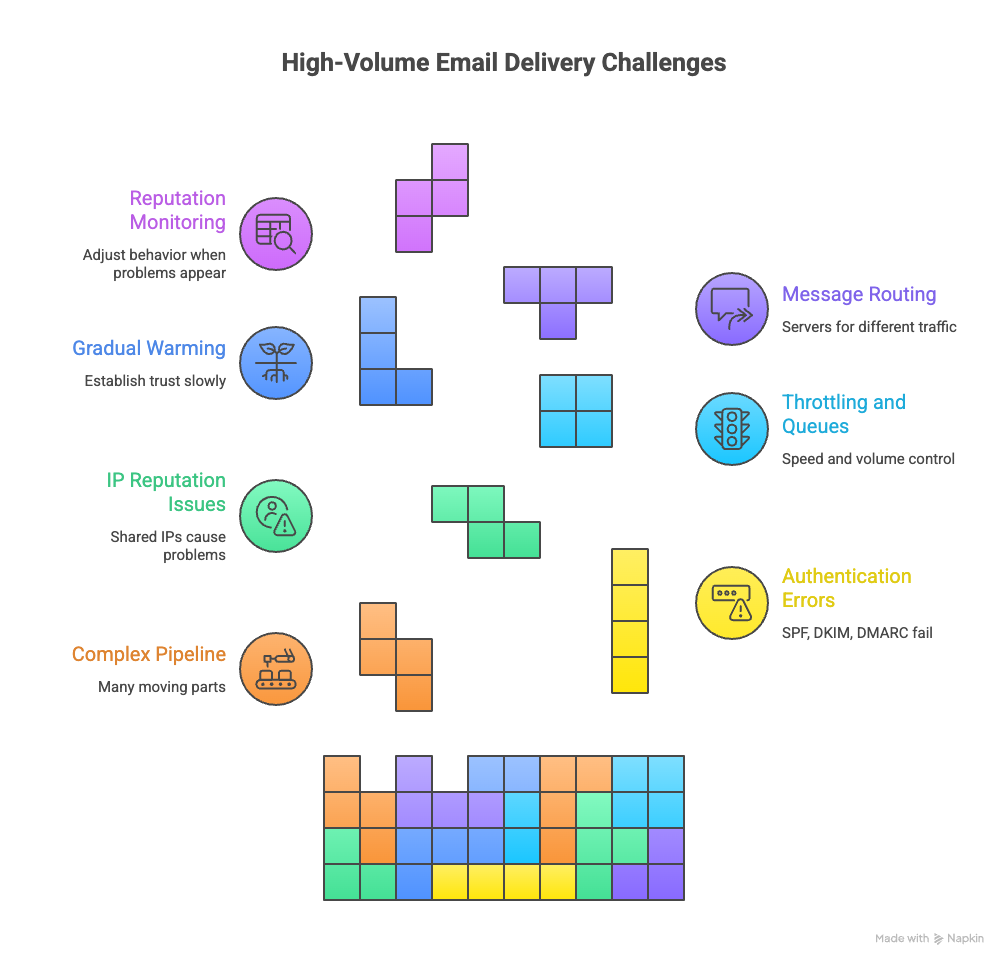
Behind every large-scale sending operation is a pipeline that starts with domain provisioning and authentication using SPF, DKIM, and DMARC. IP addresses are then assigned, either shared or dedicated, and traffic is placed into sending queues that control speed and volume. Domains and IPs must be warmed gradually to establish trust with mailbox providers before full volume is reached.
Messages are routed through specific servers depending on their purpose, such as transactional or marketing traffic, and delivery events are logged in detail. Reputation is monitored continuously, and sending behavior is adjusted when problems appear.
Most companies only learn how fragile this system is after it collapses for the first time.
Mission Inbox mirrors this model at the infrastructure level. Domains are provisioned and authenticated automatically; traffic is segmented by workload before it ever enters a queue, and IP reputation is owned by the sender rather than shared across unrelated customers.
That design choice is why teams using the platform stop seeing “random” deliverability drops. When something degrades, it is visible, contained, and traceable to a specific stream.
Who needs this type of platform?
This market is smaller than people think. It is not aimed at casual senders.
For SaaS and product teams, email is part of the application itself. Password resets, login codes, alerts, invoices, and onboarding flows all depend on reliable delivery. When email fails, the product fails.
Sales and marketing operations teams at fast-growing companies face different problems. Their challenge is scaling outbound or lifecycle campaigns without damaging inbox placement or interfering with transactional traffic.
Agencies face another risk entirely. When one client’s behavior can harm the reputation of the infrastructure used by every other client, shared systems become dangerous. Isolation becomes a business requirement.
Compliance-driven organizations such as financial services or healthcare platforms need audit logs, access controls, data residency options, and message traceability. Many traditional ESPs were never designed to support this properly.
These were the exact profiles Mission Inbox was designed around: product teams that cannot afford failed password resets, revenue teams that need scale without domain burn, agencies that require hard isolation between clients, and compliance-driven organizations that need message-level traceability.
The platform is intentionally overkill for small senders. It is built for organizations where email failure shows up on financial reports, not just dashboards.
The moment companies are forced to switch
Almost nobody plans to buy email infrastructure.
They are pushed into it.
The trigger is usually a slow deliverability death spiral. Open rates start collapsing even though targeting and content have not changed. Domains begin to get flagged repeatedly. Gmail and Outlook start throttling traffic. Accounts are suspended “for review” without clear timelines. Marketing campaigns begin delaying invoices or OTP emails, and support teams spend more time dealing with missing messages than real customer problems.
At that point, cheap email becomes the most expensive part of the stack.
What actually matters at high volume?
Once volume grows, features like templates and drag-and-drop editors stop mattering. Structural control takes over. Mission Inbox is structured around these points.
Dedicated IPs become critical because shared reputation means shared risk. When you own the IP reputation, problems become predictable and solvable instead of random.
Workload isolation becomes non-negotiable. Transactional traffic, billing messages, and outbound campaigns should never compete for the same queues or servers. A cold campaign should never be able to delay a password reset.
Domain automation becomes necessary. Manual setup does not scale when managing dozens or hundreds of sending identities. Infrastructure platforms automate provisioning, authentication, rotation, and retirement.
Queue management and throttling must adapt dynamically based on provider feedback and reputation health. Static limits eventually fail.
Deliverability monitoring must show where messages land, not just whether they were sent. Inbox placement, blacklist detection, bounce classification, and complaint tracking are mandatory at scale.
Compliance also becomes unavoidable. Authentication enforcement, encrypted transport, access control, data retention policies, and audit-grade logging stop being optional once email becomes part of regulated workflows.
Finally, application-level integration is required. Email infrastructure must plug directly into products through APIs, SMTP relays, and webhooks, not sit behind a marketing dashboard.
The three categories of platforms
Not all providers solve the same problem.
Traditional ESPs such as Amazon SES, Mailtrap, Mailgun, SendGrid, and Postmark are strong choices for transactional email and moderate scale. They offer solid APIs and mature tooling, but isolation and reputation control are limited unless you invest heavily in dedicated infrastructure.
Cold outreach infrastructure platforms like Mailforge, Infraforge, Inframail, and similar tools specialize in rapid inbox creation and outbound scale. They are optimized for sales teams but often treat transactional traffic as secondary and provide limited compliance tooling.
Infrastructure-first platforms, including Mission Inbox, are built around isolation, reputation ownership, compliance, and multi-workload support. They are designed to run transactional, lifecycle, and outbound traffic in parallel without interference.
They cost more and require more serious onboarding, but they remove the structural risks that cause most high-volume failures.
.png)
Dedicated IPs vs shared IPs
Shared IPs are cheap and simple, but unpredictable.
Dedicated IPs require more setup but provide long-term stability. At scale, stability is what protects revenue.
If email volume is part of your business model, a dedicated reputation is not a luxury feature. It is the baseline.
Why compliance becomes unavoidable
Once email becomes part of billing, security, or regulated workflows, infrastructure must support proper authentication enforcement, encrypted transport, granular access control, detailed event logging, data retention rules, and regional routing where required.
Even if engineering teams do not prioritize this early, legal and finance teams eventually will.
Real-world outcomes
Ali Syed was running campaigns on legacy Google-based infrastructure. Deliverability fluctuated weekly despite stable targeting and copy.
After migrating to isolated servers with dedicated reputation control, inbox placement stabilized and performance roughly doubled. The audience and content stayed the same. Only the infrastructure changed.
Dmitriy Katsel runs high-volume lead generation campaigns. Before switching, deliverability was his main business bottleneck, and domains were constantly under pressure.
After moving to dedicated infrastructure, volume scaled safely and inbox placement stabilized. He described lead flow returning to levels he had not seen in over a decade.
In both cases, the underlying change was the same: moving from shared, opaque infrastructure to isolated, reputation-owned delivery through Mission Inbox.
No targeting changes. No copy rewrites. No list cleaning.
Just control over the system that actually determines whether email arrives.
Why content does not fix broken infrastructure
Most teams try to solve deliverability problems with better subject lines.
Infrastructure teams see the real causes: queue congestion, cross-traffic contamination, and reputation poisoning.
A perfect email still fails if it sits behind a marketing blast on a polluted IP.
This is why workload isolation matters more than copy optimization once volume grows.
This is the core assumption behind Mission Inbox’s design.
Optimizing subject lines while traffic competes in shared queues is like tuning an engine while the fuel line is contaminated. The platform treats isolation as the first optimization, not the last.
What success looks like after six months?
For serious senders, success becomes boring.
Millions of emails are delivered every month. Inbox placement remains stable. Domains stop burning. Providers stop suspending their accounts. Emergency deliverability audits disappear.
Engineering teams stop touching email systems. Sales teams stop talking about spam folders.
Email goes back to being infrastructure, not a weekly crisis.
Who this is for, and who is it not?
Email infrastructure platforms make sense for SaaS products, marketplaces, agencies, lead generation companies, financial platforms, and high-growth startups sending tens of thousands to millions of emails per month.
They do not make sense for small newsletters, low-volume senders, budget-only buyers, or short-term operators.
Infrastructure is not a shortcut. It is a commitment to reliability.
When to seriously consider switching?
If deliverability is unpredictable, domains burn repeatedly, transactional and marketing traffic interfere with each other, providers throttle growth, or compliance requirements are increasing, infrastructure should already be on your roadmap.
Why do some teams never need this?
Many businesses will never outgrow traditional ESPs, and that is fine.
Mission Inbox is not designed to replace lightweight sending tools. It exists for teams who have already learned that email is part of their operational infrastructure, not just a communication channel.
If email failure creates revenue risk, customer churn, or compliance exposure, infrastructure becomes a business decision, not a technical preference.
Build email infrastructure that does not break at scale
If email is already part of how your product runs, how you bill customers, or how your sales engine operates, then the delivery layer should not be an afterthought.
Mission Inbox is built for teams that have outgrown shared infrastructure and need predictable delivery, isolated workloads, and full control over domain reputation.
If that sounds like where you are heading, you can explore the platform or speak with the team to understand how it would fit your setup.